
Об игре
The mission statement of Crosstalk is that we would like it to bring back the joy of tinkering, designing things from near-scratch, and taking one's time with something while letting people connect and collaborate. We don't see that much anymore in computing.
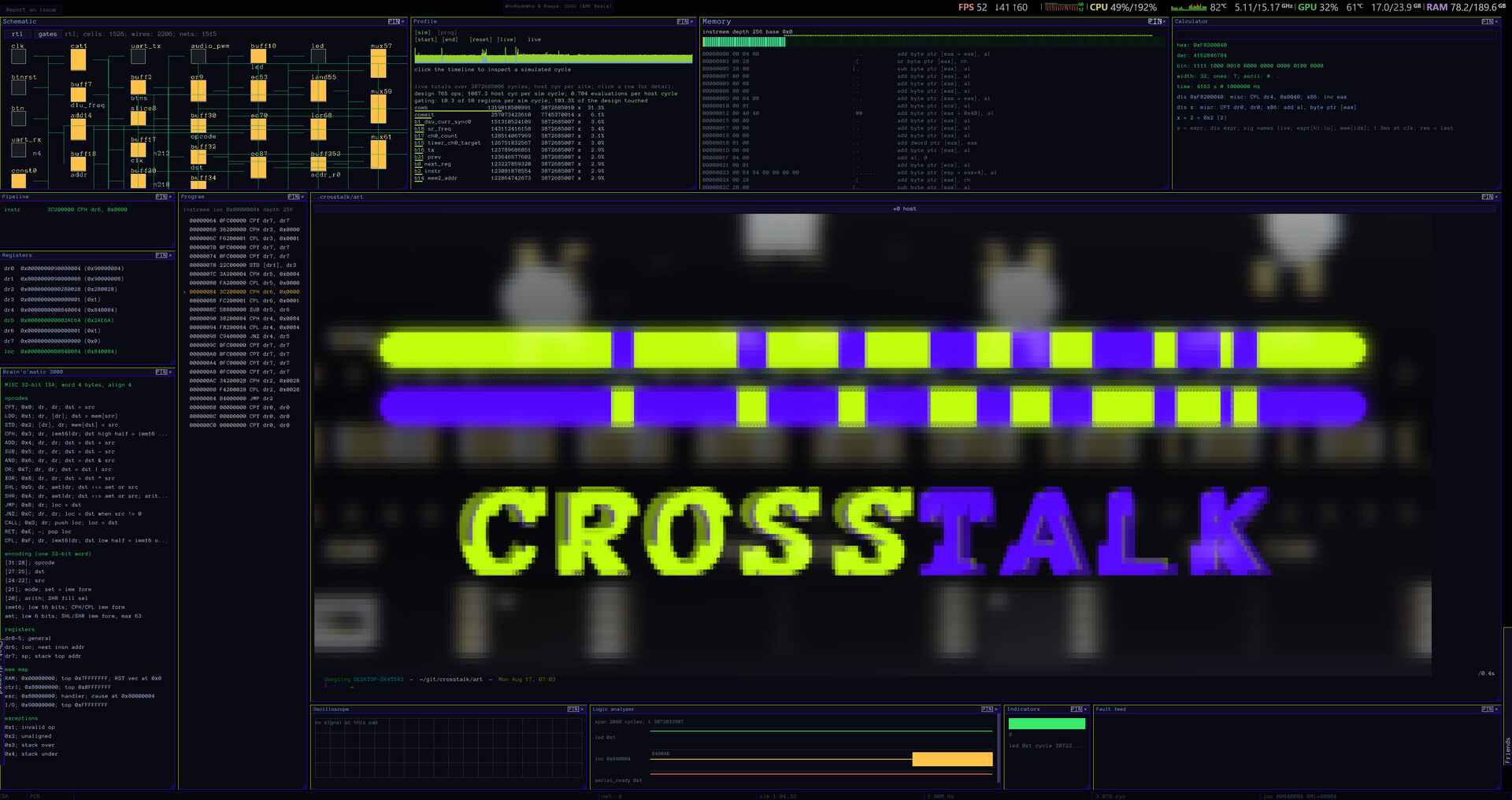
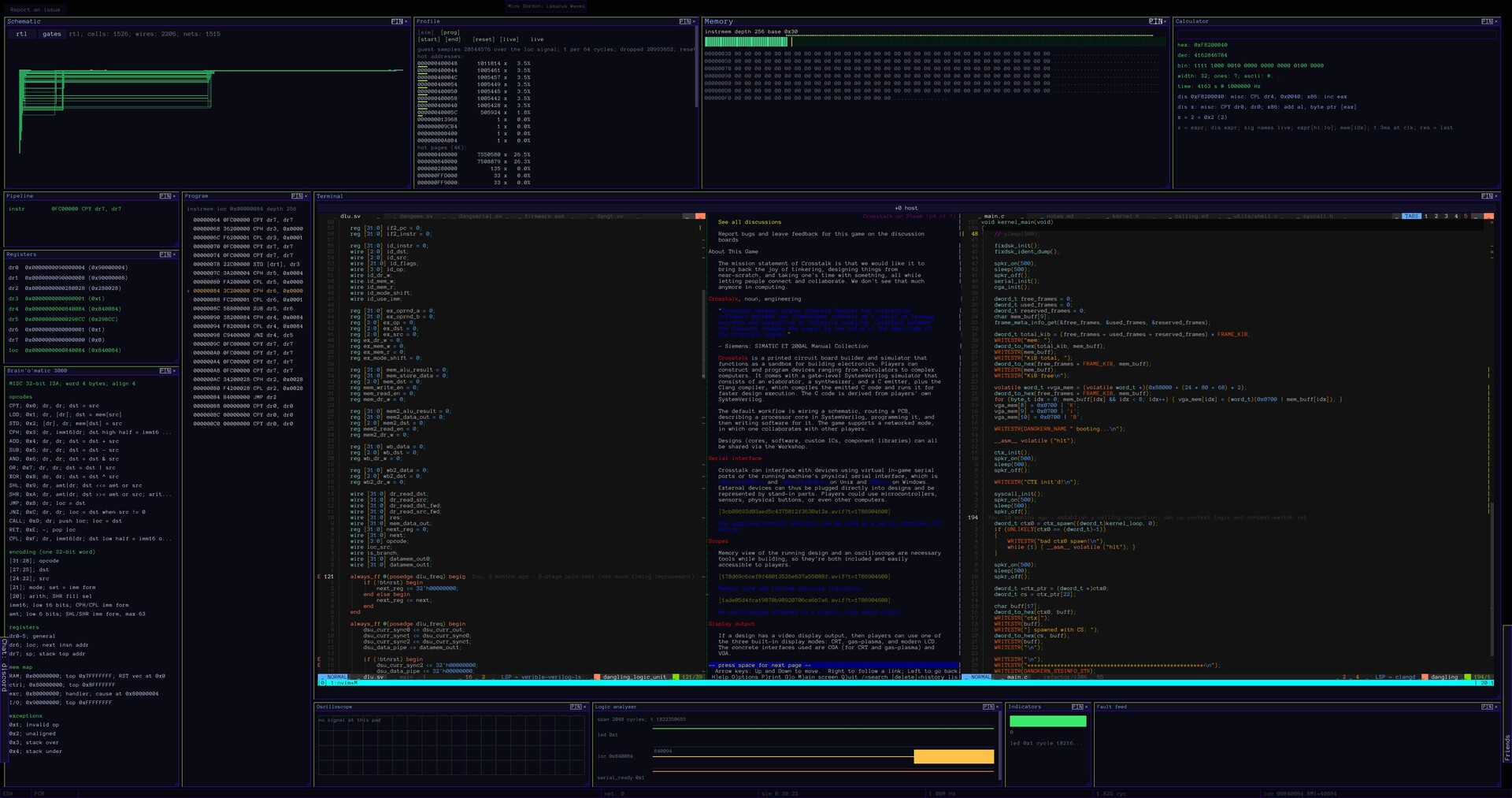
Crosstalk is an RTL sandbox with a simulator and an emulator for building electronics. Players can construct and program devices ranging from calculators to complex computers. It comes with a gate-level SystemVerilog simulator that consists of an elaborator, a synthesizer, and a C emitter, plus the Clang compiler, which compiles the emitted C code and runs it for faster design execution. The C code is derived from players' own SystemVerilog.
The default workflow is opening the RTL workspace, entering a shell, describing a design in SystemVerilog, programming it, and then writing software for it. The game supports a networked mode, in which one collaborates with other players.
Designs (cores, software, emulators) can all be shared via the Workshop.
Serial interface
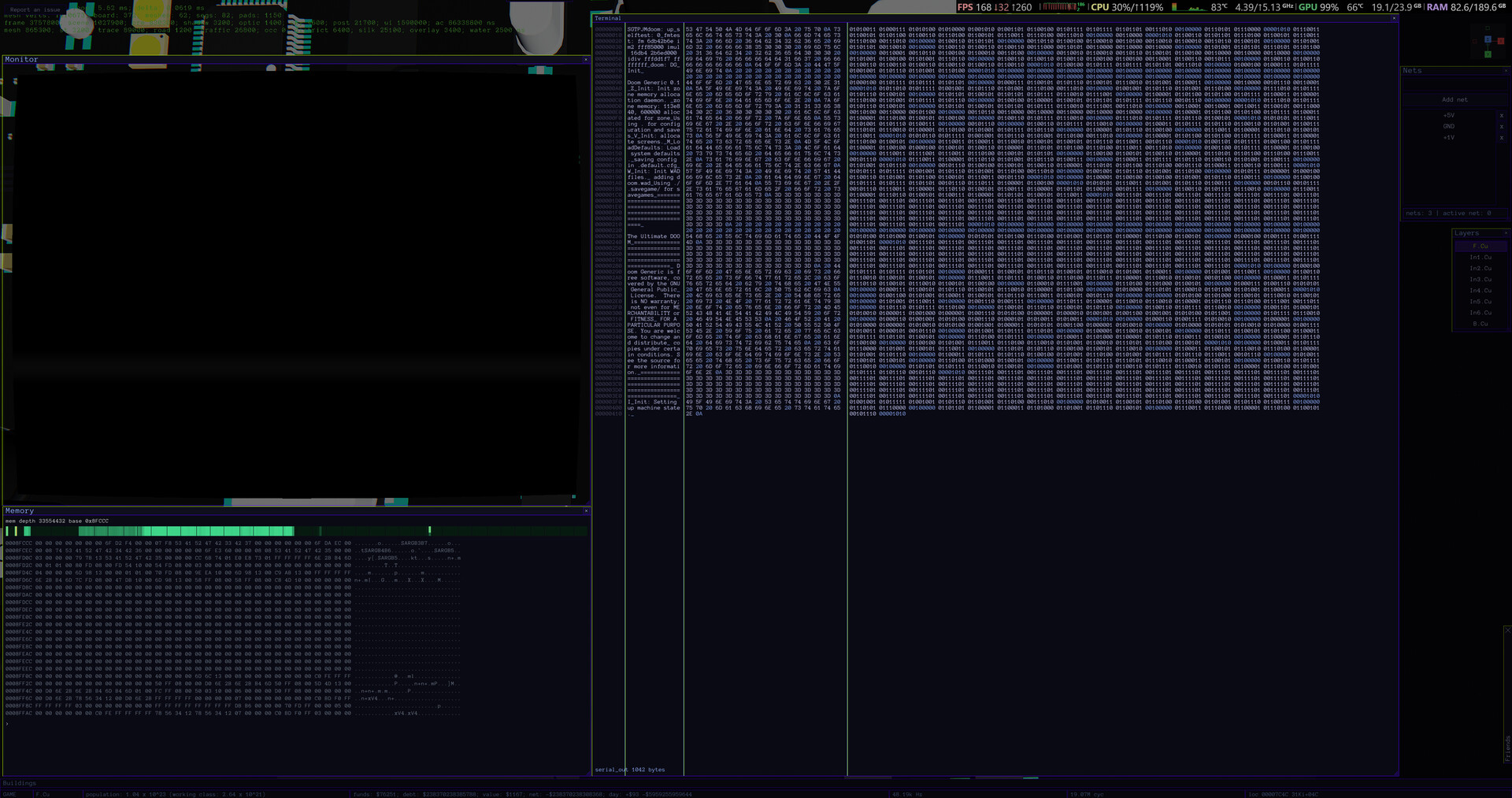
Crosstalk can interface with devices using virtual in-game serial ports or the running machine's physical serial interface, which is /dev/ttyUSB<n> and /dev/ttyACM<n> on Unix and COM<n> on Windows, or its own shell interface. External devices can thus be plugged directly into designs and be represented by stand-in parts. Players could use microcontrollers, sensors, physical buttons, or other computers.
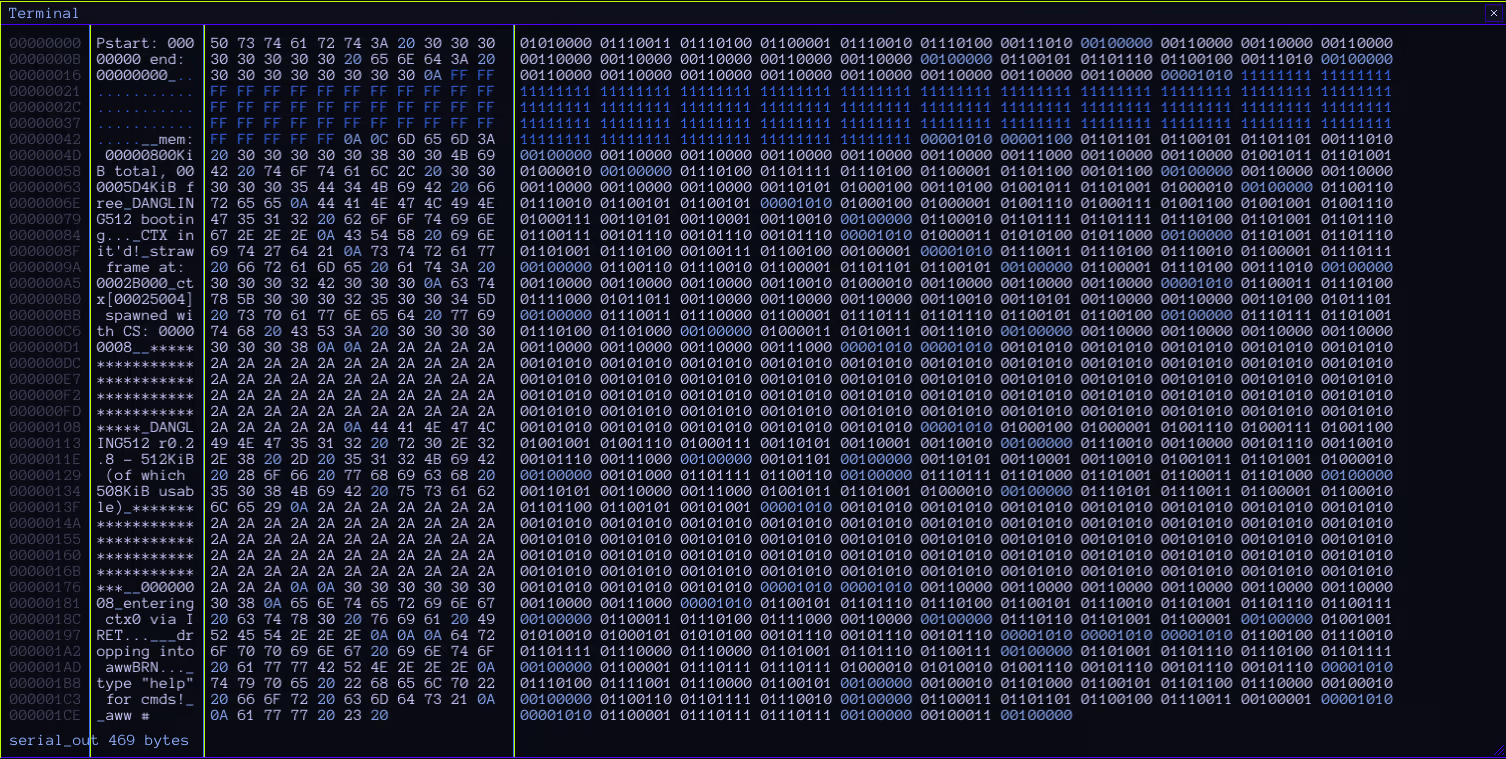
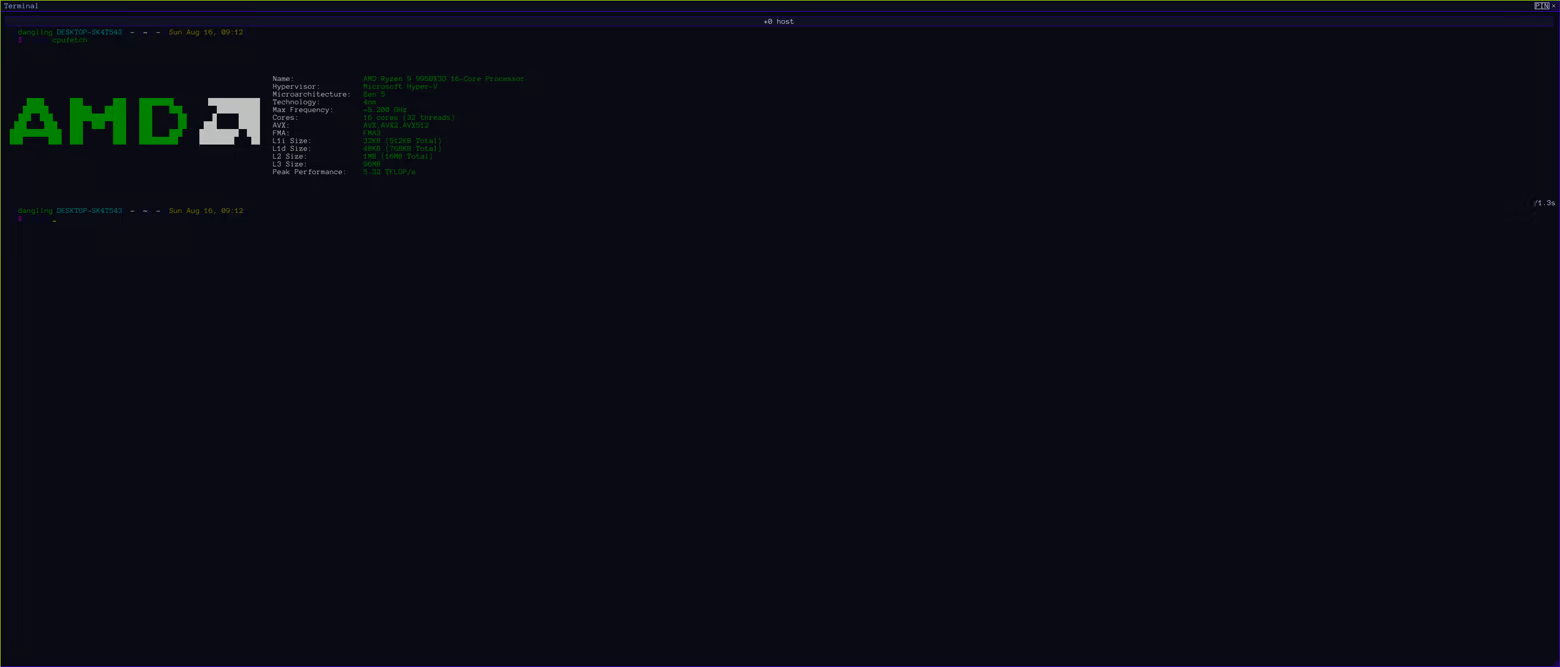
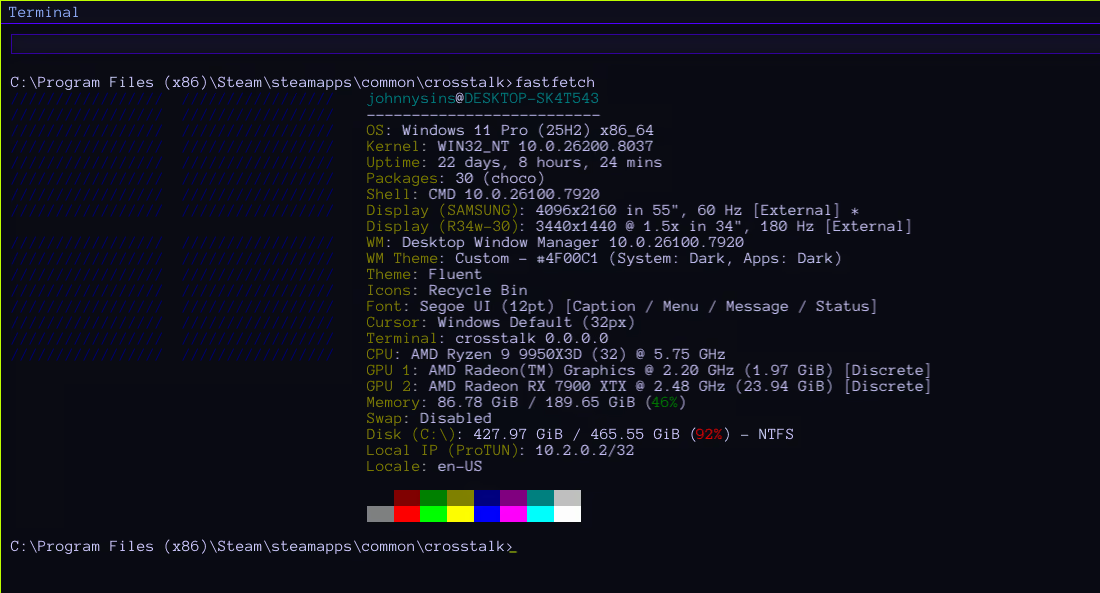
The supplied truecolor terminal emulator can be used as a serial terminal I/O device. It is ANSI/VT100/xterm/kitty-compatible and can interact with the host over a PTY/ConPTY
Serial I/O works with physical devices. The above is TX.
RX
Scopes
Memory view of the running design and an oscilloscope are necessary tools while building, so they're both included and easily accessible to players.
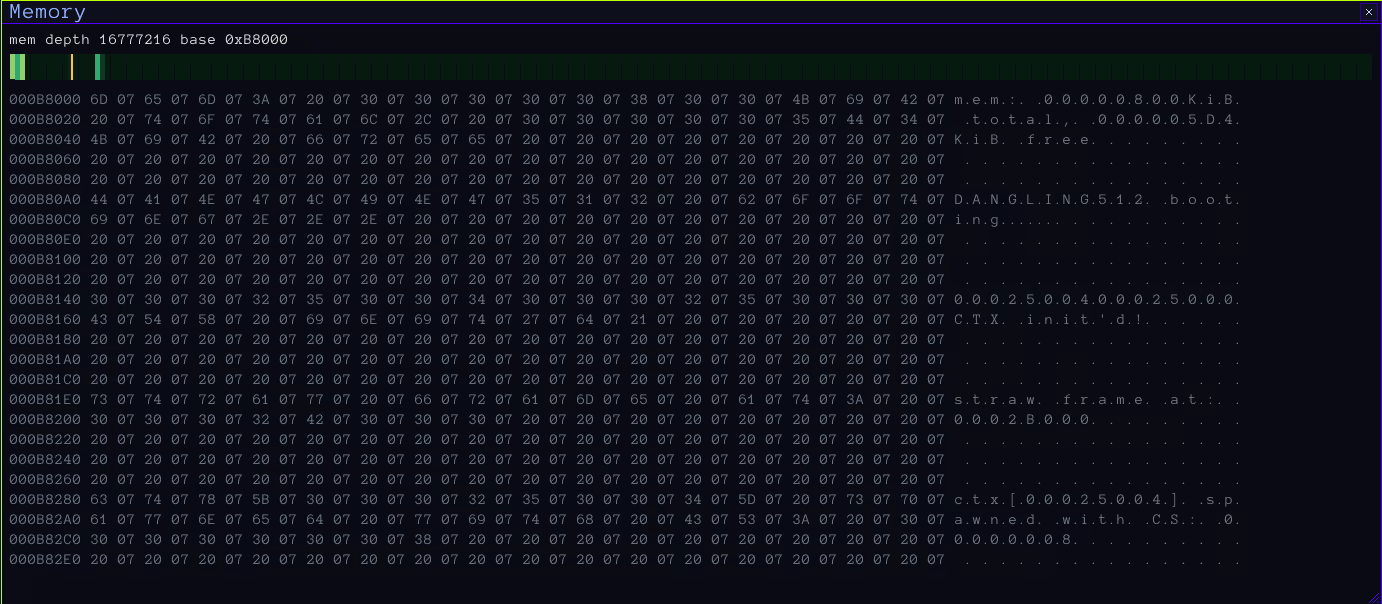
Memory view and runtime activity indication
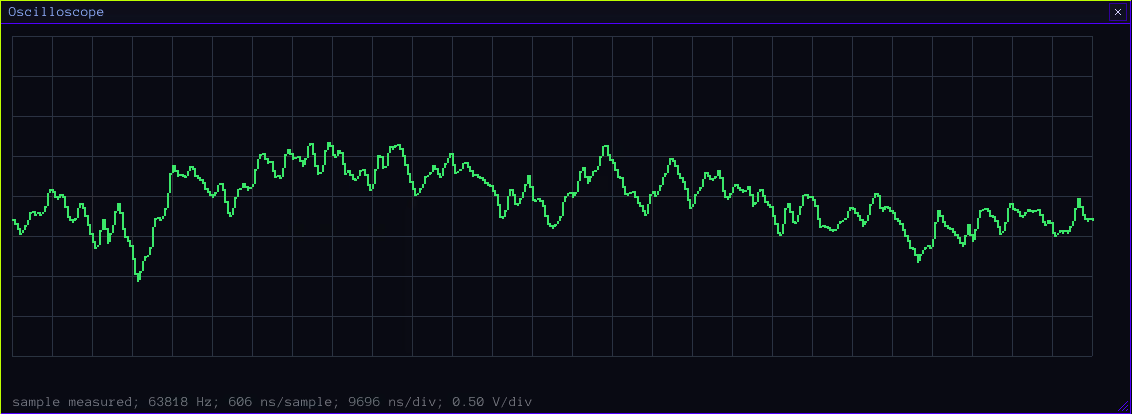
An oscilloscope attached to a signal, like sound output
Display output
If a design has a video display output, then players can use one of the three built-in display modes: CRT, gas-plasma, and modern LCD. The concrete interfaces used are CGA (for CRT and gas-plasma) and VGA.
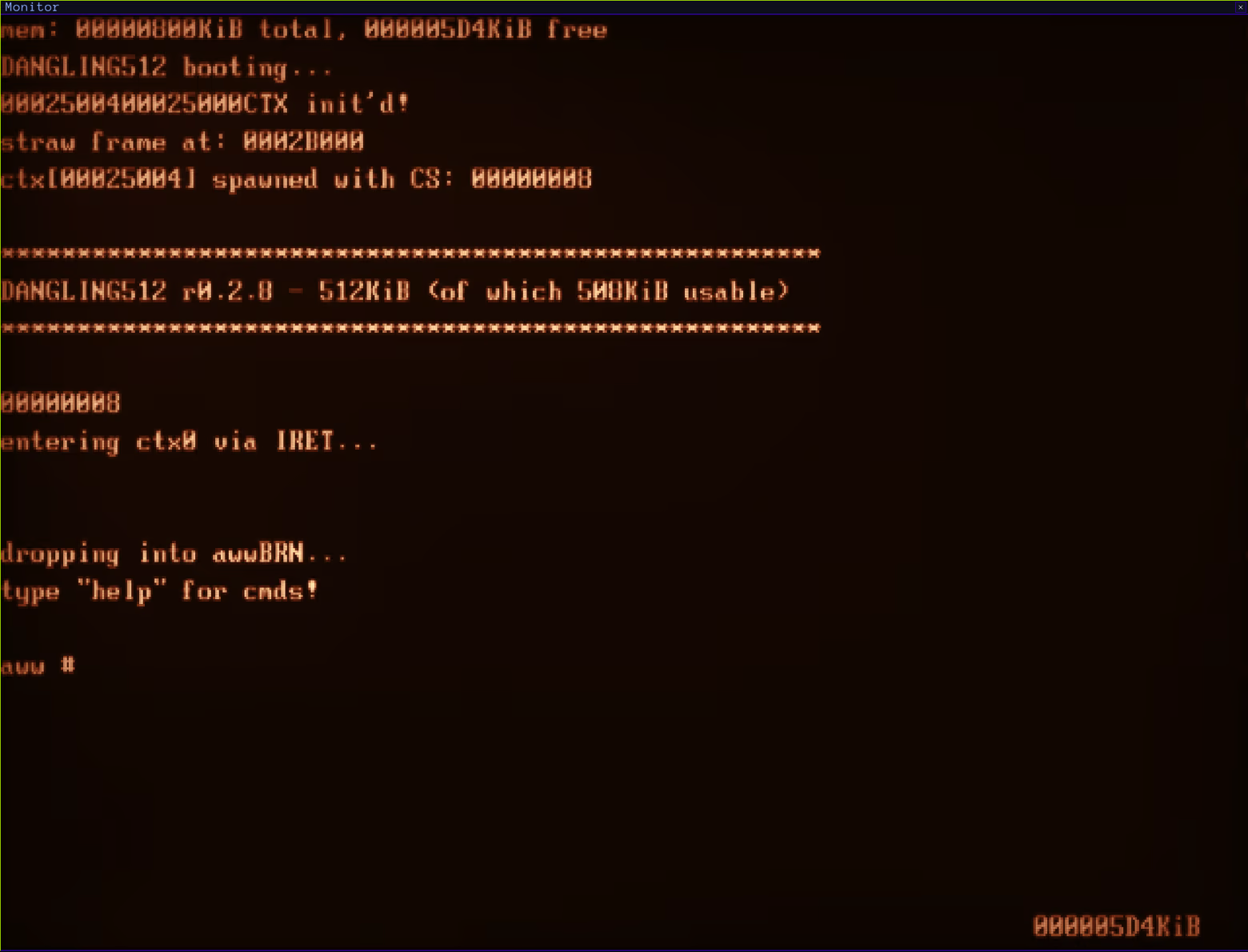
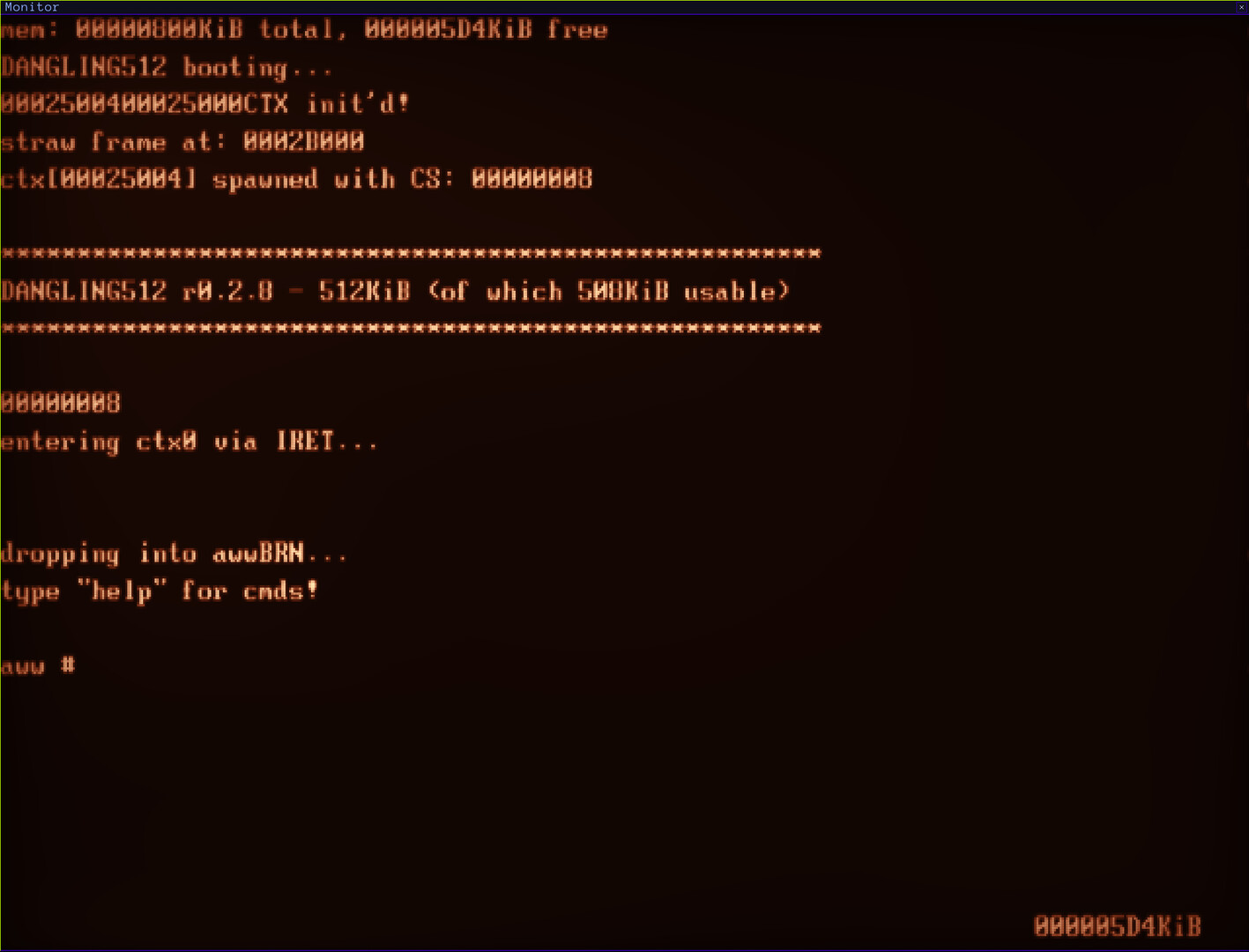
A CGA gas-plasma display output type showing the DANGLING kernel booting on an i386-compatible CPU, in-game
The in-game displays are interactive
CPU architecture design
Players can define ISAs and then view a help banner in the game while developing. Later on, a DLC with a guided ISA design feature set will be released.
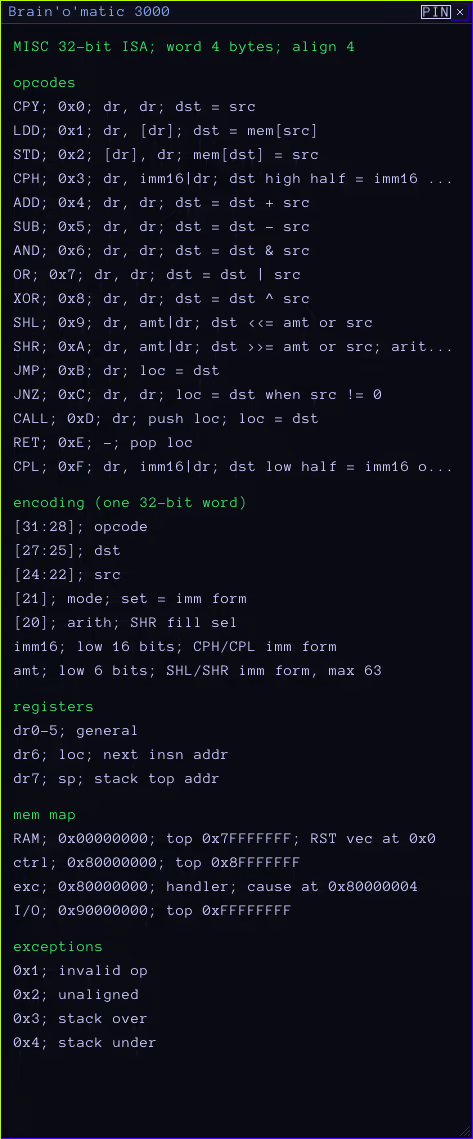
The Minimal Instruction Set Computer ISA
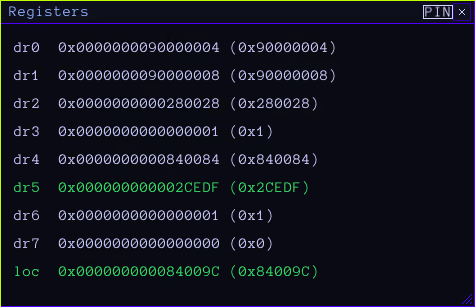
Runtime register state overview
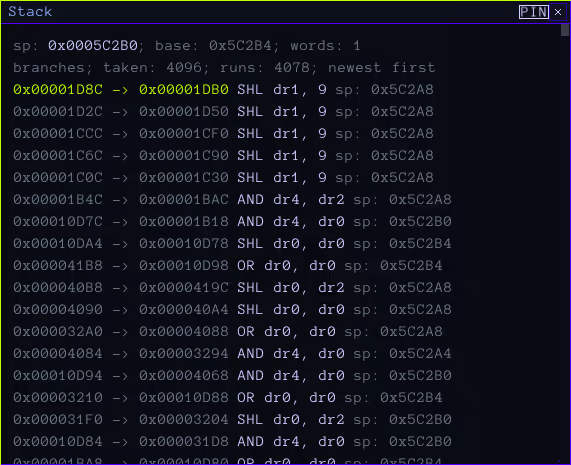
A stack view that shows a trace on faults
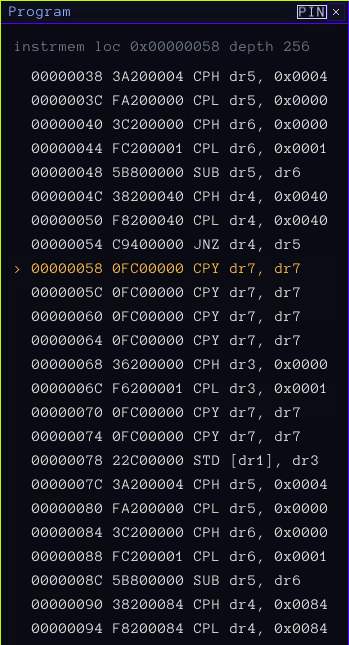
Program locator overview
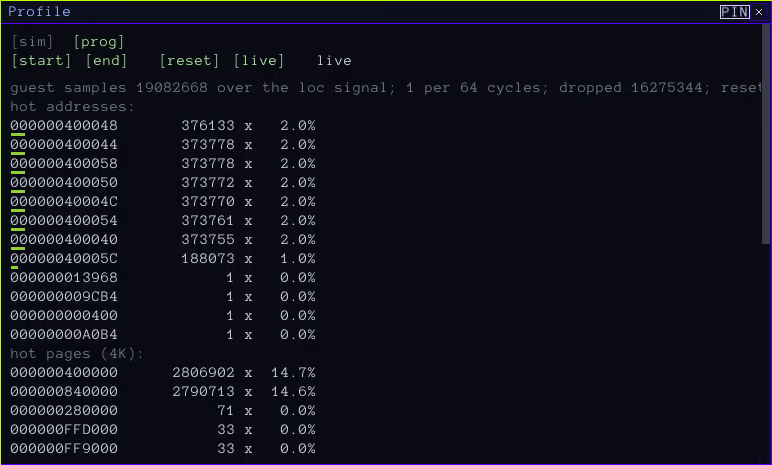
The program-level Profiler mode shows where time is going during a program's runtime
SystemVerilog
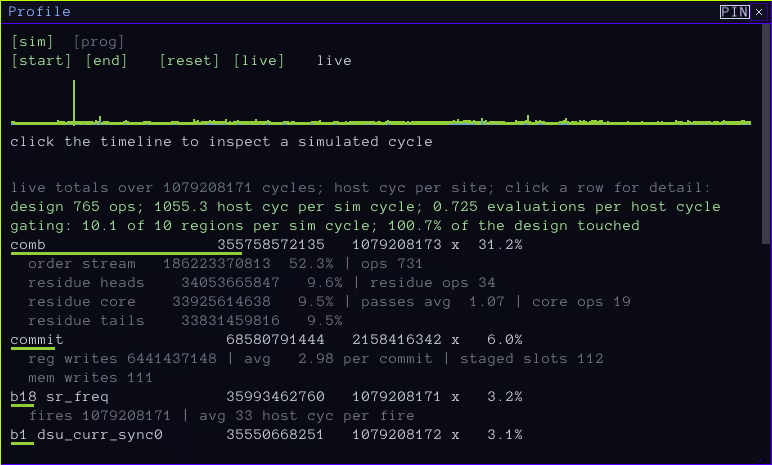
The included Profiler shows an overview of where cycles within the SV design are spent
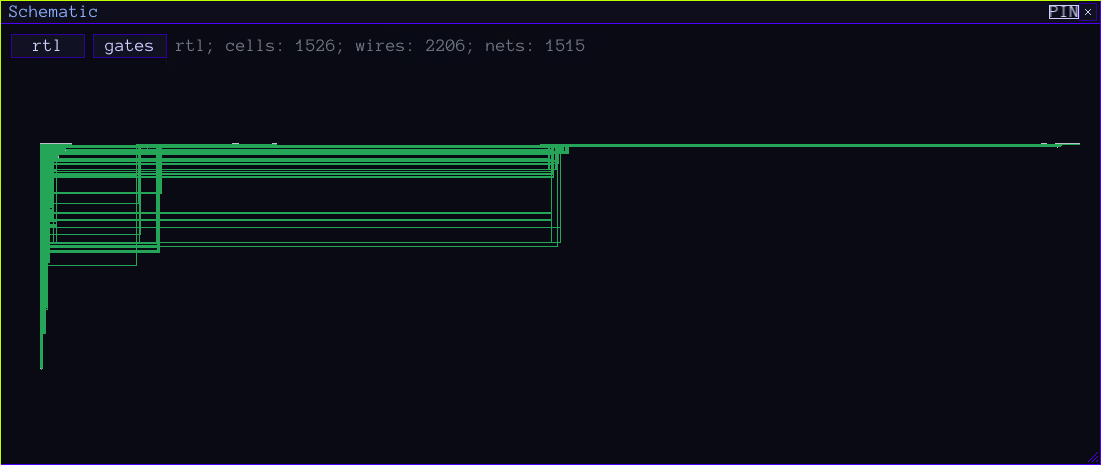
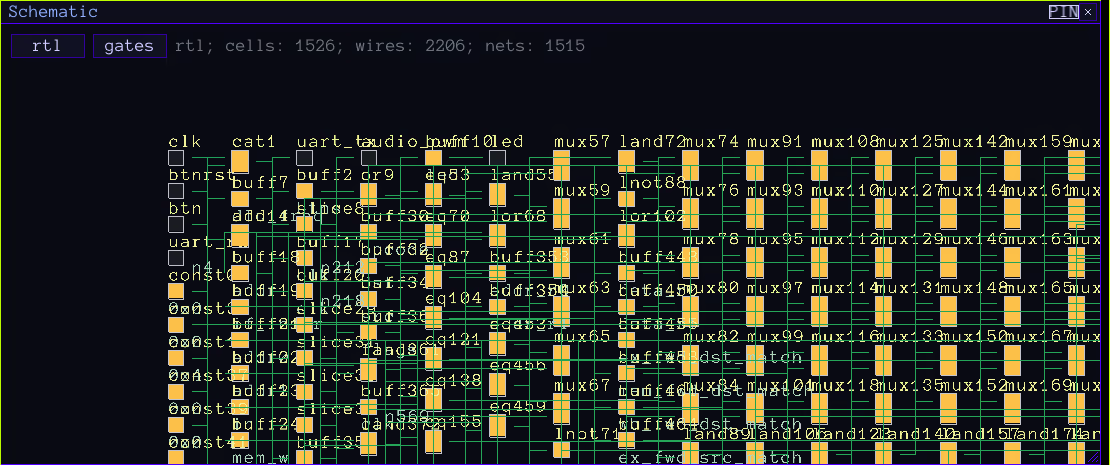
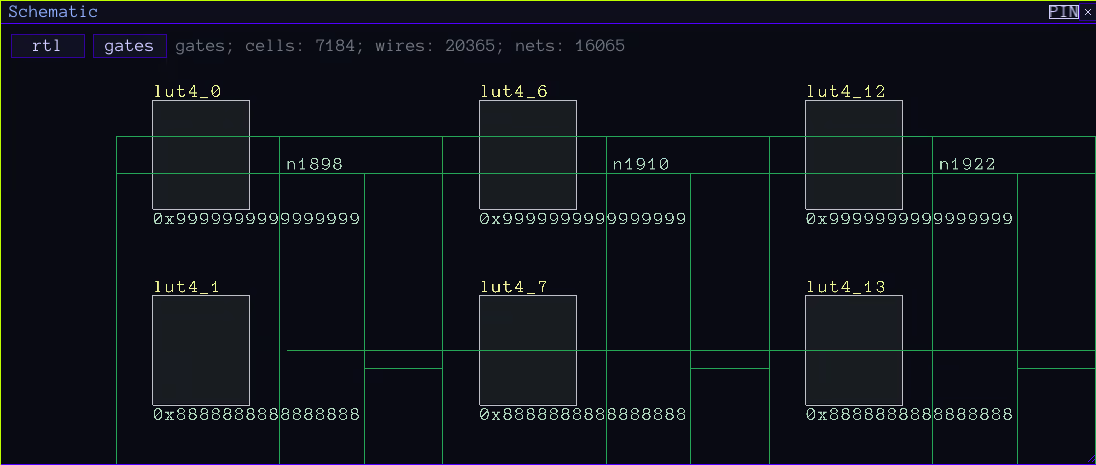
The interactive Schematic viewer shows both the RTL and the gate-level schematic and in profile mode, highlights hot cells
The Minimum Instruction Set Computer ISA + The DANGLING Logic Unit CPU
The game comes with a custom instruction set architecture and its first CPU, which serve as both a reference SystemVerilog implementation and a target for players who don't want to make a custom one. MISC is already capable of running complex programs, despite being very minimal.
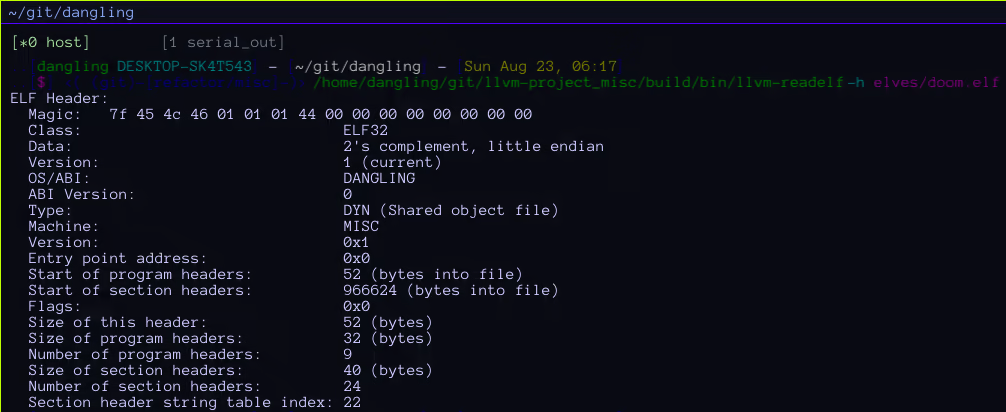
The LLVM that ships with the game can compile for the MISC architecture
Sandbox mode
Self-play submode
Sandbox mode is the default Crosstalk experience. Players can create a custom workspace with resizable, positionable, and alignable floating windows. Most use-cases start with opening a shell session to their host, invoking their editor, and writing SystemVerilog. Once there is a valid design, it can be simulated inside Crosstalk.
Networked submode
In this submode, one can team up with others over Steam Networking and build together. It is structurally identical to Self-play mode, but with networking enabled.
DLC


Скриншоты

Системные требования
Минимальные Requires a 64-bit processor and operating system OS: Windows 10 1809 Processor: 2.4GHz quad-core Memory: 4 GB RAM Graphics: VRAM >=4Gi Network: Broadband Internet connection Storage: 3 GB available space Additional Notes: Vulkan >=1.3 required; simulated clock linearly follows single-core frequency multiplied by IPC Рекомендуемые Requires a 64-bit processor and operating system OS: Windows 11 Processor: 4.6GHz octa-core Memory: 16 GB RAM Graphics: VRAM >=12Gi Network: Broadband Internet connection Storage: 10 GB available space Additional Notes: Vulkan >=1.3 required (discrete Vk device recommended); simulated clock linearly follows single-core frequency multiplied by IPC
minimum: Minimum: recommended: Recommended:
Минимальные OS: Linux 5.0 Processor: 2.4GHz quad-core Memory: 8 GB RAM Graphics: VRAM >=6Gi Storage: 12 GB available space Additional Notes: Vulkan >=1.3 required Рекомендуемые OS: Linux 7.0+ Processor: 4.6GHz octa-core Memory: 16 GB RAM Graphics: VRAM >=12Gi Storage: 24 GB available space Additional Notes: Vulkan >=1.3 required (discrete Vk device recommended)